
Insights

Why Google’s AI Search Guidance is Misleading
May 20, 2026
Google’s recently released AI search guidance suggests that businesses, including law firms, should rely primarily on traditional SEO, reinforcing that its AI-driven results are built on the same core ranking systems as its existing search model. This is a familiar message: Keep doing SEO. Don’t overthink AI. Don’t chase new tactics. However, this advice is misleading at best and perhaps even a bit disingenuous, as it contradicts Google’s own recommendations. In practice, it illustrates the gap between platform-specific guidance and market reality, not to mention an important, yet oft-glossed-over, nuance: context makes all the difference when choosing the right visibility strategy.
When you step outside of Google’s ecosystem and look at how AI-driven discovery works across platforms, including OpenAI (ChatGPT), Microsoft Copilot, Perplexity AI, and Anthropic (Claude), a very different picture emerges. Even within Google’s own ecosystem, there are inconsistencies. While its guidance downplays the importance of structured data, its commerce and agent-based experiences increasingly require schema and structured feeds, suggesting the reality is more complex than their narrative implies.
AI search optimization is an evolution of SEO, not a replacement and not a completely new playbook. The fundamentals still matter: crawlability, content quality, authority, and technical integrity remain the foundation. What’s changed is how that foundation is interpreted, distributed, and validated across a fragmented ecosystem of AI-driven platforms.
This isn’t about throwing out what works or chasing every new “AI tactic.” But it’s also not a moment to stand still. It requires building on SEO with a more deliberate, cross-platform approach to visibility. Firms that treat this shift as incremental will fall behind, while those that overcorrect risk losing the strategic discipline SEO built. Like most real-world solutions, the answer is somewhere in the middle. But make no mistake, the opportunity and advantage are in adapting to this new stage of evolution.
Google’s New Guidance “Nothing Has Changed” for AI Search is Misleading
Google’s recently released guidance outlines how websites can appear more prominently in their AI-driven search results. The main takeaways include:- Structured data is not critical
- You don’t need to “optimize for AI”
- Chunking and technical structuring are overblown
- AI visibility is just an extension of traditional SEO
In other words: stay the course. That advice may be sound if your entire visibility strategy lives inside Google Search. However, Google search is no longer the only gateway to discovery, and ranking is no longer the only measure of visibility.
Google still dominates “total search” behavior, but pure AI platforms are rapidly capturing “high-intent informational discovery” (e.g., research, comparison, education, planning, and validation type queries). Analysts now estimate that AI search accounts for ~15–30% of “informational query” behavior. In other words, Google still owns navigational and transactional intent searches, but AI search systems are increasingly becoming the go-to for all research and consideration queries.
For now, traditional search still answers the majority of queries, but AI search now owns decision-making. For B2B law firms, the impact is evident; inclusion in AI-generated answers is essential, and that cannot be accomplished by just following Google’s narrow guidance.
AI systems evaluate your law firm differently, pulling from multiple sources, interpreting context, and assembling answers in ways that extend beyond traditional search results.
Searches conducted through pure LLM platforms like OpenAI’s ChatGPT, Anthropic’s Claude, and Microsoft’s Copilot are increasingly competing with Google’s dominance in the search landscape. While Google’s guidance may reflect how visibility works within its own ecosystem, it presents an incomplete picture. If the other models are overlooked, firms will not be evaluated, surfaced, and recommended across the broader AI search landscape.
It’s also worth noting that, based on Google’s broader guidance and product updates, many of these elements, particularly structured data, content organization, and technical clarity, continue to play an important role in how content is understood and surfaced within its AI experiences.
Where Google’s Guidance Breaks Down
1. Structured Data Isn’t Required But in Practice, It Still MattersGoogle's new position is that structured data is optional. In reality, structured data is becoming foundational to how AI systems interpret and trust information.
Across AI platforms:
- Microsoft explicitly states schema helps machines interpret content “with confidence”
- ChatGPT relies on structured attributes like reviews and entity relationships
- Google’s own commerce ecosystem requires structured feeds for eligibility
Even within Google’s orbit, there’s a contradiction. Their AI guidance downplays structured data, while their product teams require it for participation in AI search.
2. Chunking Isn’t a Myth It’s Core Infrastructure
Google dismisses “chunking” as unnecessary. Chunking is the process of breaking long documents or datasets into smaller, self-contained segments (chunks) before feeding them to an AI. It’s like having a big book, but instead of reading the whole thing, you only look at the few pages that answer your question. This allows AI crawlers to understand your firm faster. It is a foundational step in building AI search and Retrieval-Augmented Generation (RAG) applications.When Google says chunking isn’t necessary, that’s a little misleading. All AI tools, like ChatGPT or Microsoft Copilot, already do this automatically. They don’t read entire websites at once, rather they:
- Break content into smaller pieces
- Look for the most helpful parts
- Use those parts to answer your question
Even Google does this. Instead of reading a whole page, it looks for the exact sections that match what you asked. It’s not really a “strategy” you choose; it’s just how AI works behind the scenes. Even if you don’t do it yourself, your content will still be read in smaller pieces.
3. “Just Do SEO” is Only True Inside Google
Google’s guidance repeatedly reinforces that AI visibility is rooted in its ranking systems. But that’s only accurate for Google AI summaries.It’s not accurate for the broader AI ecosystem:
- ChatGPT surfaces results based on its own retrieval + partner systems
- Perplexity builds answers from its own index and product graph
- Microsoft Copilot runs on Bing infrastructure, not Google
- Claude operates independently of Google’s ranking signals
AI search systems don’t share a single ranking logic. They don’t even share a single index.
So when Google says “just do SEO,” what they mean is “just optimize for Google.”
That’s not the same thing as optimizing for AI-driven discovery. While it’s important to optimize for Google, being visible in a broader context necessitates expanding on traditional SEO tactics.
4. AEO/GEO Isn’t Hype; The Market Is Already There
Google frames Answer Engine Optimization (AEO) and Generative Engine Optimization (GEO) as overhyped. However, this philosophy does not align with the emergence of new AI search platforms.Despite Google’s stance, Microsoft acknowledges GEO as a legitimate evolution of SEO.
The terminology is evolving because there is a real underlying shift in the digital landscape.
Boston Consulting Group estimates AI search will surpass Google search in late 2027.
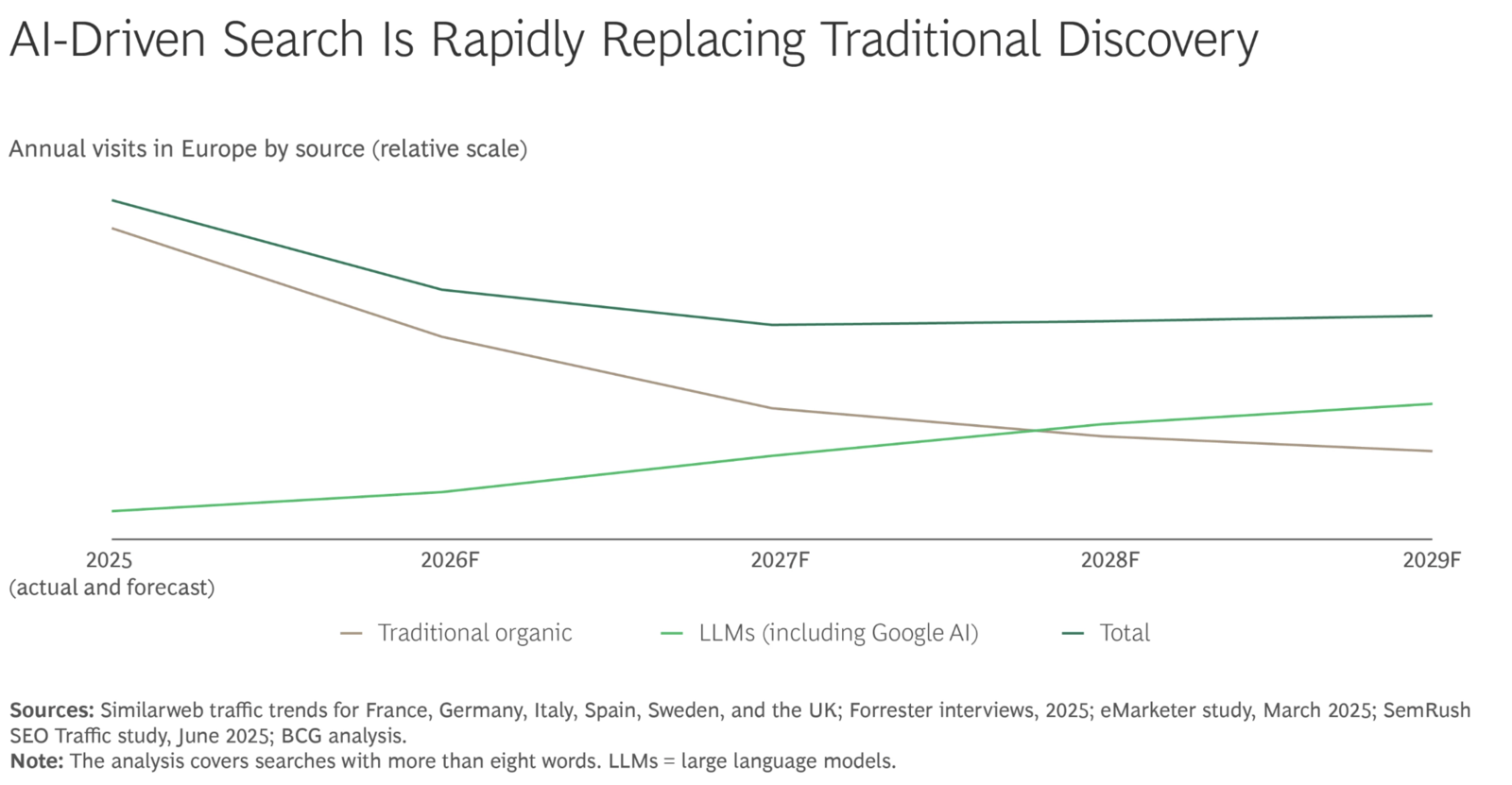
This means optimizing to appear in platforms beyond Google will continue to grow in importance. Rankings in these new LLMs will require a solid SEO foundation, but structured data, strong content programs, and a digital entity strategy will bridge the gap between Google and other AI-driven search platforms.
What This Means for Law Firms
AI visibility is quickly becoming digital visibility. And digital visibility is visibility in our mobile-first, digitally driven world. AI systems are not ranking pages the way search engines did. They’re ranking entities.
Law firms must strategically position themselves online so that AI platforms, and to a degree, Google can validate experience and reconcile signals across its entire digital footprint.
To make these judgment calls about which firms surface, AI search platforms review:
- Website structure and internal linking
- Consistency across directories, rankings, and press
- Depth and specificity of content
- Structured data and machine-readable relationships
- External validation (awards, mentions, citations)
This Isn’t About Google vs. AI
Google’s guidance isn’t wrong; it’s just incomplete and one-sided. It reflects Google’s incentives, ecosystem, and internal definition of AI search.But the market has already moved beyond a single-platform model for AI search. Discovery now happens across traditional search engines, AI assistants, embedded AI recommendation systems, and other AI search platforms beyond Google.
And each of these systems evaluates your firm differently.
If you follow Google’s guidance alone, you will be well-optimized for Google. But you will be under-optimized for everything else.
And increasingly, “everything else” is where early-stage discovery and online referral validation happen.
Law firms must now work to be understood and appear credible and authoritative across all AI-driven systems. This shift requires:
- Structured, connected content ecosystems
- Clear positioning and topical authority
- Technical infrastructure that supports machine interpretation
- Consistent signals across every digital touchpoint
We are experiencing an evolution of SEO. This change is bigger than Google. By leveraging the foundations of SEO and adapting tactics to a broader definition of online visibility, law firms will be successfully positioned for the future.
Build on what works, but adapt it for how machines now understand, validate, and recommend experience. Because ignoring the shift won’t protect your visibility, it will erode it.